1329 W Walnut Hill Ln, Ste 104, Irving, TX 75038
 (972) 449-9329
 Patient Portal


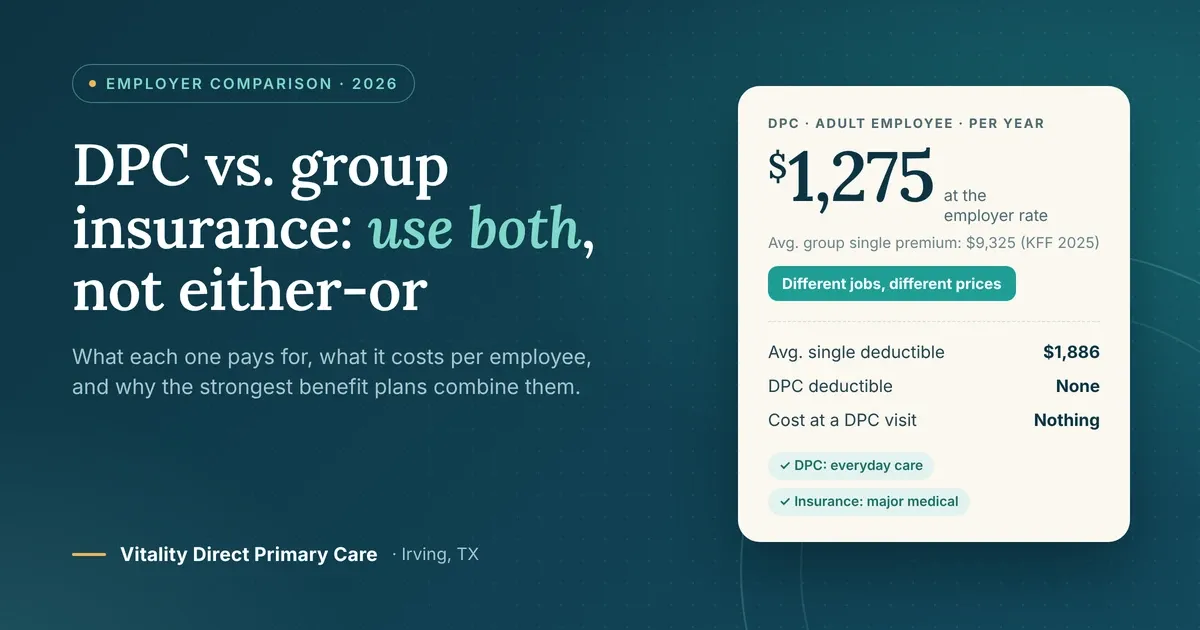
Comparing direct primary care vs. group health insurance isn’t an either-or decision. Group insurance protects employees from large, unexpected costs like surgery and hospital stays. Direct primary care (DPC) covers everyday doctor visits for a flat monthly fee with no copays or deductible. In 2025, the average employer-sponsored single plan cost $9,325 a year, while an adult DPC membership at Vitality DPC’s employer rate costs $1,275 a year.
When you sit down with a benefits broker during open enrollment, the conversation usually centers on premiums, networks and deductibles. Direct primary care rarely comes up, even though it changes how employees use their benefits every week.
This guide puts the two side by side so Irving employers can see what each one does, where each falls short, and why many businesses end up using both.
What is the main difference between DPC and group health insurance?
The main difference is what each one is built to pay for. Group health insurance is a risk-pooling product. Everyone pays a premium so that the few people who face a major medical event don’t carry the full cost alone.
Direct primary care is a service membership. The employer pays a flat fee to a primary care practice, and members get ongoing access to their doctor. There is no claim, no deductible and no bill at the visit.
Put simply, insurance is protection against the big and rare. DPC is access to the small and frequent.
How do DPC and group insurance compare side by side?
The table below compares the two across the factors employers ask about most.
| Factor | Group health insurance | Direct primary care |
|---|---|---|
| What it pays for | Hospital, surgery, specialists, emergencies, prescriptions, some primary care | Primary and preventive care, with discounted labs |
| How it’s priced | Monthly premium per employee, rising each year | Flat monthly fee per member |
| Cost at the visit | Copay, coinsurance or full price until the deductible is met | Nothing |
| Deductible | Average $1,886 for single coverage (2025) | None |
| Access | Depends on network and appointment availability | Same-day or next-day visits, plus phone, text and video |
| Visit length | Often short | Up to 60 minutes |
| Paperwork | Claims, explanations of benefits, prior authorizations | None for routine care |
| Meets the ACA employer mandate (50+ full-time employees) | Yes, if the plan qualifies | No |
Source for premium and deductible figures:
How much does each option cost an employer?
Group insurance costs far more because it covers far more. KFF’s 2025 Employer Health Benefits Survey reports an average annual premium of $9,325 for single coverage and $26,993 for family coverage. Workers contributed an average of $1,440 toward single coverage.
DPC has a narrower scope and a much lower price. At Vitality DPC, an adult employee aged 19 to 64 costs $125 a month at the standard rate, or $106.25 a month when five or more employees enroll. That’s $1,275 a year. A family of up to five pays no more than $300 a month. See the full breakdown on the membership page.
The two figures aren’t interchangeable. Dropping insurance to save money would leave employees exposed to costs DPC was never designed to handle.
What happens to deductibles and copays under each model?
Deductibles are where the two models feel most different to employees. KFF found the average deductible for single coverage reached $1,886 in 2025. At firms with 10 to 199 workers, it was $2,631, and 53% of covered workers at those firms faced a deductible of $2,000 or more.
For an employee with a $2,500 deductible, a routine sick visit, a lab panel and a follow-up can all come out of pocket. Many people respond by skipping care.
Under DPC, those same visits cost the employee nothing. Sick visits through acute care and preventive care are included in the membership, and labs are discounted. The deductible only comes into play for the services insurance still handles.
Which option gives employees faster access to a doctor?
DPC generally gives faster, more direct access. A DPC practice keeps a smaller patient panel, so appointments are easier to get.
Vitality DPC members can usually get a same-day or next-day appointment at the Irving clinic. They can also reach Dr. Sana Haq by phone, text, email or video, and many issues are handled through telemedicine without a trip to the office.
Insurance doesn’t control access directly. It depends on which practices are in network and how busy they are.
Which option works better for employees with chronic conditions?
For ongoing conditions, DPC usually gives more consistent day-to-day support. Conditions like high blood pressure, diabetes and COPD need regular check-ins, medication adjustments and lab work.
Under a typical insurance plan, each of those touchpoints can trigger a copay or count toward the deductible. Employees often stretch the time between visits to save money, and small problems grow.
Under DPC, follow-ups cost nothing extra. Members can send a blood pressure reading by text, ask about a side effect, or book a longer visit when something changes. Vitality DPC offers hypertension management and COPD management as part of the membership.
Insurance still matters here. Specialist referrals, hospital care and many brand-name prescriptions run through the plan, not the membership.
Who carries the financial risk in each model?
With group insurance, the insurer or a self-funded employer carries the risk of high claims. That’s why premiums rise after a costly year, and why small groups can see sharp renewal increases.
With DPC, the practice takes on the cost of delivering primary care for a set fee. If an employee needs ten visits instead of two, the monthly price doesn’t change. For employers, that makes primary care spending predictable even when a few people need a lot of attention, such as employees working through diabetes management or blood pressure control.
Why do employers often use DPC and group insurance together?
Using both covers the full range of care without paying twice for the same thing. Insurance stays in place for emergencies, hospital stays, surgery and specialist referrals. DPC takes over the everyday visits that make up most interactions with the healthcare system.
A common setup is a high-deductible health plan paired with DPC. The lower premium of the high-deductible plan helps offset the membership cost. Employees get primary care with no per-visit fees, without touching the deductible for routine needs.
Since January 1, 2026, a DPC membership of up to $150 a month for an individual or $300 for a family no longer blocks HSA eligibility. That makes this pairing easier for employers who offer HSA-qualified plans.
Can DPC replace group insurance for a small business?
For most businesses, no. DPC doesn’t cover hospital care, surgery, emergencies or specialists, and it doesn’t satisfy the Affordable Care Act’s employer coverage requirement for larger employers.
Some very small businesses that can’t afford a group plan use DPC as their first benefit. Even then, employees should keep individual coverage for major medical needs. Talk with your broker or benefits advisor about the right structure for your company.
How can Irving employers compare their own numbers?
The best comparison uses your actual team. A free 20-minute discovery call with Vitality DPC in Irving gives you an exact monthly quote you can set beside your current renewal.
Ready to compare? Call (972) 449-9329, book a free discovery call, or use the contact page.
FAQs
Is direct primary care cheaper than group health insurance?
Yes, but it covers much less. An adult DPC membership at Vitality’s employer rate costs $1,275 a year, while the average employer single-coverage premium was $9,325 in 2025.
Does direct primary care count as health insurance?
No. DPC is a membership for primary and preventive care. It doesn’t cover hospital stays, surgery, emergencies or specialist visits.
Can an employer offer both DPC and group insurance?
Yes. Many employers pair DPC with a high-deductible plan so employees get primary care with no per-visit fees while insurance handles major medical costs.
Does DPC meet the ACA employer mandate?
No. Employers subject to the ACA employer mandate still need to offer qualifying health coverage. DPC can be added on top.
Do employees pay anything at a DPC visit?
No. Primary care visits are included in the membership. Labs, imaging and medications are offered at discounted prices.
Can employees use an HSA with DPC?
Yes. Since January 1, 2026, a DPC membership up to $150 a month for an individual or $300 for a family doesn’t block HSA eligibility.